Learn about provider-specific instructions required for initial integration setup and deductions setup.
Before setting up any integration through Finch, review the provider’s setup requirements below — not all providers require additional setup, only those listed here.
To connect to AlphaStaff, employers provide their 6-digit Client ID in Finch Connect.After providing this, the employer receives a notification from AlphaStaff within 7 business days confirming Finch’s access to their data. Once confirmed, Finch can start fetching data for the employer. During this setup period, any requests to the Finch API using the employer’s access tokens return a 202 response with the message “Authorization to this company’s data is pending”.If an employer does not know their Client ID, they can contact AlphaStaff to retrieve it.
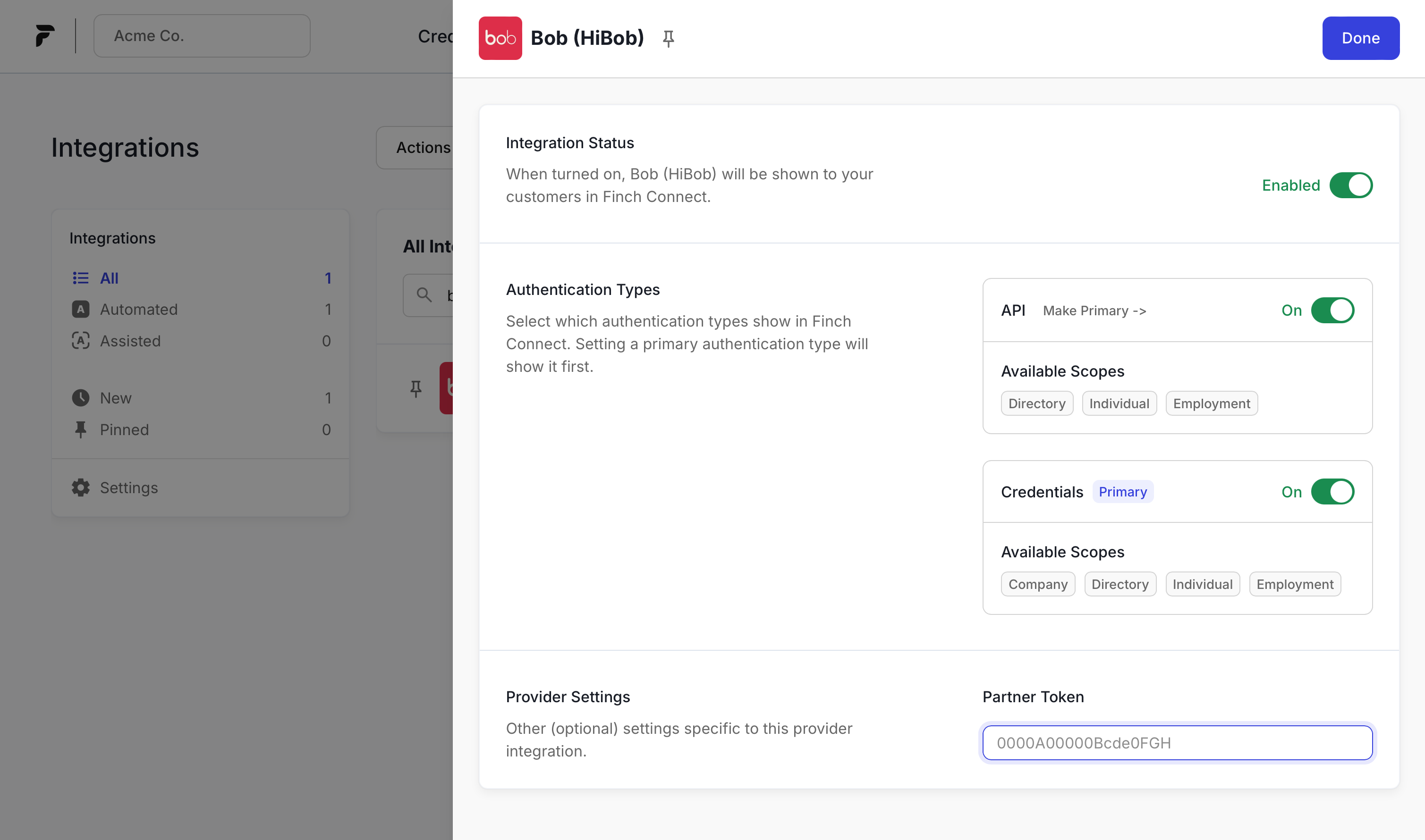
If you have a direct partnership with Bob, provide your Partner Token to Finch so Finch can use that token when sending requests to Bob on your behalf. You can do this directly in the Client Dashboard by going to Integrations, selecting Bob, and providing the value in the Partner Token field.Being a partner does not change your integration or usage with Finch — this requirement lets Bob track requests it receives on behalf of its direct partners.
To integrate with Deel, create a Deel account and OAuth application, then connect your Deel OAuth application to Finch. See the Deel Onboarding Guide for detailed instructions.
To integrate with Factorial, create a Factorial account and OAuth application, then connect your Factorial OAuth application to Finch. See the Factorial Onboarding Guide for detailed instructions.
Gusto requires a one-time security review before you can access their production API. Finch first vets your security requirements, then provides you with Gusto’s security questionnaire to complete. Gusto’s review typically takes 2–4 weeks, plus any additional time for follow-up requests from Gusto.Follow the Gusto Onboarding Guide for the full process, including creating a Gusto Developer Portal account. You’ll also be asked to agree to Gusto’s Terms of Service.
Paylocity connections start in the Paylocity Marketplace. For each application Paylocity approves, Paylocity lists a tile named <Your application> via Finch, and Finch holds the Paylocity credentials for that tile. When an employer requests your tile, Finch redirects them to your application with a Finch Connect session, and your application launches Finch Connect to finish the connection.Follow the Paylocity Onboarding Guide to set up your tile and handle the redirect from Finch. Contact your Developer Success Engineer to confirm whether Paylocity has approved your application.
Enabling a Rippling integration requires an onboarding process that includes a review by Rippling for eligibility to become a Rippling partner. Finch submits the application on your behalf and keeps you updated. See the Rippling Setup Guide for Developers for more information.Employers need the Identity & Access Management package for Finch to retrieve data from Rippling.
TriNet requires a one-time security review before you can integrate.
Start the review. Contact your Implementation Engineer or email implementation-team@tryfinch.com to initiate the TriNet security review with Finch.
Complete the field validation spreadsheet. Finch shares a field validation spreadsheet — fill it out and notify your Implementation Engineer or Finch Technical Support when it’s done.
Wait for TriNet’s approval. Finch submits the review to TriNet. Once TriNet approves it, your application appears in their integration center.
Connect employers. Employers can now authenticate with TriNet by following the directions in Finch Connect.
A handful of Workday department fields can be made available upon request. See our field support for all fields supported by default.For Company data, departments[].source_id is populated with the IDs of the Workday supervisory organizations for the company and is available upon request. departments[].name is available for the company by default.For Directory data, department.source_id is populated with the ID of Workday supervisory organization for the worker and is available upon request. department.name is available for the worker by default.For Employment data, department.name is populated with the name of the Workday supervisory organization for the worker and is available by default.
The description field for new Deductions in Justworks must be under 30 characters. Finch’s Create Deduction endpoint returns an error if the description exceeds that limit.
Before enabling Deductions for Paychex, confirm that each employer has configured their benefits appropriately in their Paychex account. See our instructions for employers to configure their Paychex deductions.
Paychex has a 20-character limit for Component Type Description.
To create or edit any employee benefits in TriNet, the employer must contact TriNet directly — the TriNet API can’t accommodate creating or editing employer-wide benefits. Employers instead submit a Retirement Plan Summary Setup Form with TriNet’s retirement team at least 12 days before the first pay date where a deduction would apply.Finch currently supports 401k and 401k Roth retirement savings plans. Once the benefit is created, Finch can enroll users into the benefit automatically. TriNet does not support custom_pre_tax or custom_post_tax deductions and contributions.
To enroll an individual in a Roth 401(k) with employer match, QuickBooks requires this approach since match isn’t supported on the Roth 401(k) enrollment directly:
Create a traditional 401(k) enrollment alongside the Roth enrollment
Set the employee deduction amount to $0 on the traditional enrollment
Configure the intended employer match amount as the contribution value on this traditional enrollment
Was this page helpful?
Assistant
Responses are generated using AI and may contain mistakes.